
The loudest AI conversations focus on acceleration—more automation, more transformation, more promises.
My most candid AI conversation this year centered on readiness and the danger of outrunning organizational absorption capacity.
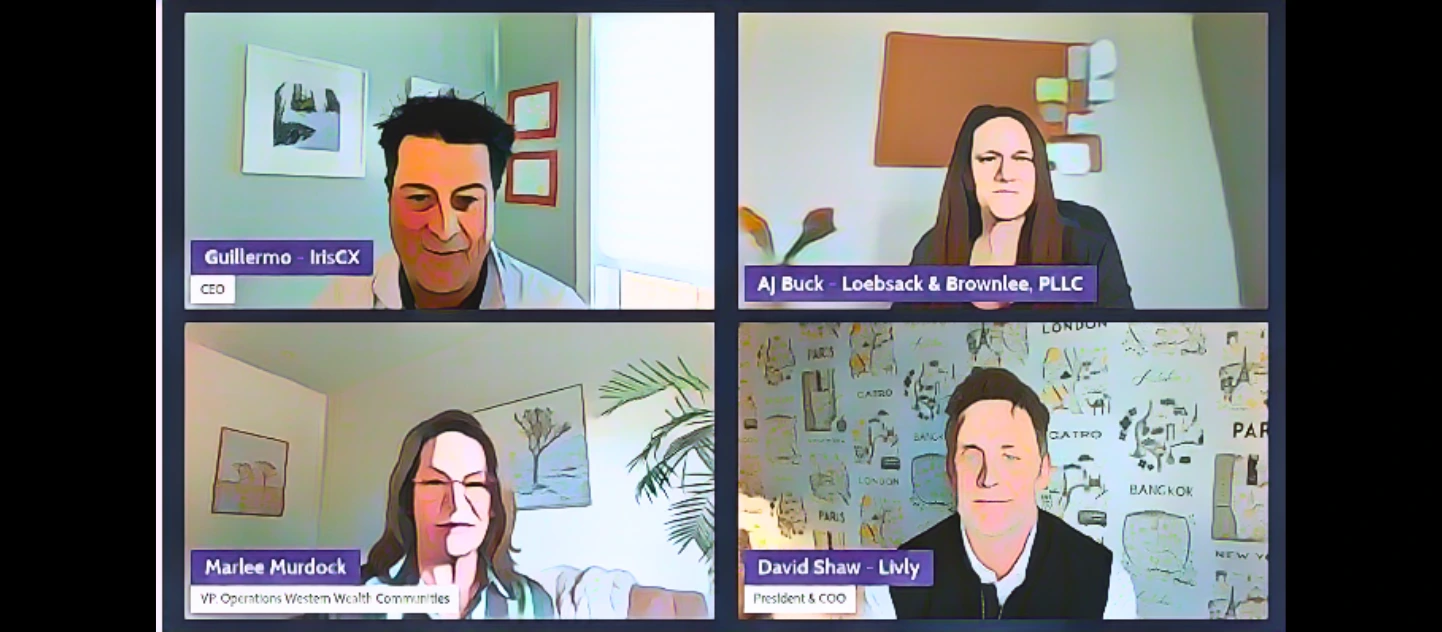
We brought together an operator, a technologist, and a legal leader. Marlana Murdoch from Western Wealth Communities, David Shaw from Lively, and AJ Buck from Loebsack and Brownlee. Not “Can AI do this?” but “Should we be doing this yet and if so, how?”
Why now?
Multifamily operations have crossed a threshold. Volume has outpaced capacity.
As David put it: “If Lively made any single mistake in its development, it was building a solution for a level of complexity that didn’t broadly exist in the market.” That complexity exists now. Volume of resident interactions, maintenance workflows, and operational data has reached and surpassed the capacity of onsite teams.
We’re not talking about inefficiency gaps anymore. We’re talking about burnout and its ripple effects.
“The biggest discussion point is really the improved customer experience, improved compliance, and also looking at reducing the workload on our already overwhelmed and overworked workforce.”
Marlana grounded the conversation immediately. Where you can automate repetitive tasks, it gives team members more capacity for high-value, resident-facing work that keeps properties healthy.
But there’s another factor: trainability. The trainability of the workforce is drastically different than five years ago, and completely different than fifteen to twenty years ago.
“Forty-one percent of leaders don’t know if their teams are using AI. Meanwhile, fifty-two percent of employees are using AI but don’t want to tell their bosses.”
AJ shared a Gallup survey result that should give every leadership team pause. Employees are already using AI such as ChatGPT, Meta AI without governance, without guardrails.
That’s not innovation. That’s an unacknowledged risk.
“Bad data in, bad data out. If you don’t have an AI policy in place, that’s company information being sent out through ChatGPT.”
When an AI tool gives incorrect guidance, violates fair housing, or advises unsafe action, liability doesn’t disappear. It lands on the organization using the tool.
“AI should be used to enhance your teams, not to replace your teams.”
From a legal perspective, you still need human eyes on things. You can’t just trust the data you’re feeding these systems.
“Operators don’t need AI transformation. What they’re looking for is fewer repetitive tasks, fewer misses, and fewer fires.”
David reframed the entire conversation. AI is a tool in the toolbox, not the end-all solution.
Most successful AI deployments today live in scripted, probabilistic workflows—assembly line work, not factories. You’re training a new set of hands to do repeatable tasks with reliable data sets.
Where it gets risky: when vendors sell the future instead of the present. When AI is positioned as a second brain without the data hygiene, governance, and escalation paths to support it.
“Be careful you’re not being sold at a factory. The world of AI today is built on a rear view mirror—the data that happened up until yesterday.”
You don’t want to drive your car looking in the rearview mirror.
“We don’t want to be swinging for home runs every single time. There’s plenty of low-risk slap singles out there.”
Pilot quickly. Decide quickly. Rip out quickly if it’s not working.
Prove value first. Make sure the steering works before you hit the gas. As David said: “It’s not unusual to expect value in the first week. If you can do what you say you’re going to do, show me in a week.”
A week is inconsequential in an organization’s lifetime. If you can smoke test in a week, try a month. It’s like dating.
“Start small. Start with those easily repeatable tasks.”
Marlana was clear about where to begin: lead management or resident satisfaction. Places where residents or prospects can self-serve with good data. Book an appointment. File a work order. Ask a simple question that doesn’t need human escalation.
“Get all of your early wins there. Those early wins not only win the hearts and minds of your IT team, they win the hearts and minds of the people who matter most—your onsite team members.”
When their job gets better, when they have time for human touchpoints instead of repetitive tasks, adoption happens.
Platform versus point solution
The platform versus point solution debate came up. Point solutions get criticized for fragmentation. Platforms get criticized for stagnation.
David’s take: “Every portfolio is a snowflake. A universal platform will get you eighty percent of the way there—and then the last twenty percent really matters.”
AJ added the implementation reality: “If a vendor can’t explain how their solution fits into your existing process, that’s where implementations break.”
The question isn’t a platform or point solution. It’s whether the tool fits your workflows, integrates responsibly, and solves a specific problem.
Still a people business
This is still a people business. That’s not changing.
The question is: how do we make the lives easier for the people who run the business?
Two truths we can all agree on:
Two years from now, you will not not be using AI. Your people are already pulling it out of your hands—to AJ’s point, half of them are already using it. Residents are pulling for it. It’s our obligation to usher it through in the smoothest, safest, most compliant way possible.
This is a “left behind” moment. But let’s not rush across the spine of the mountaintop either.
The question is whether you’re building the guardrails now or paying for the lessons later.
Check out the discussion link below: