
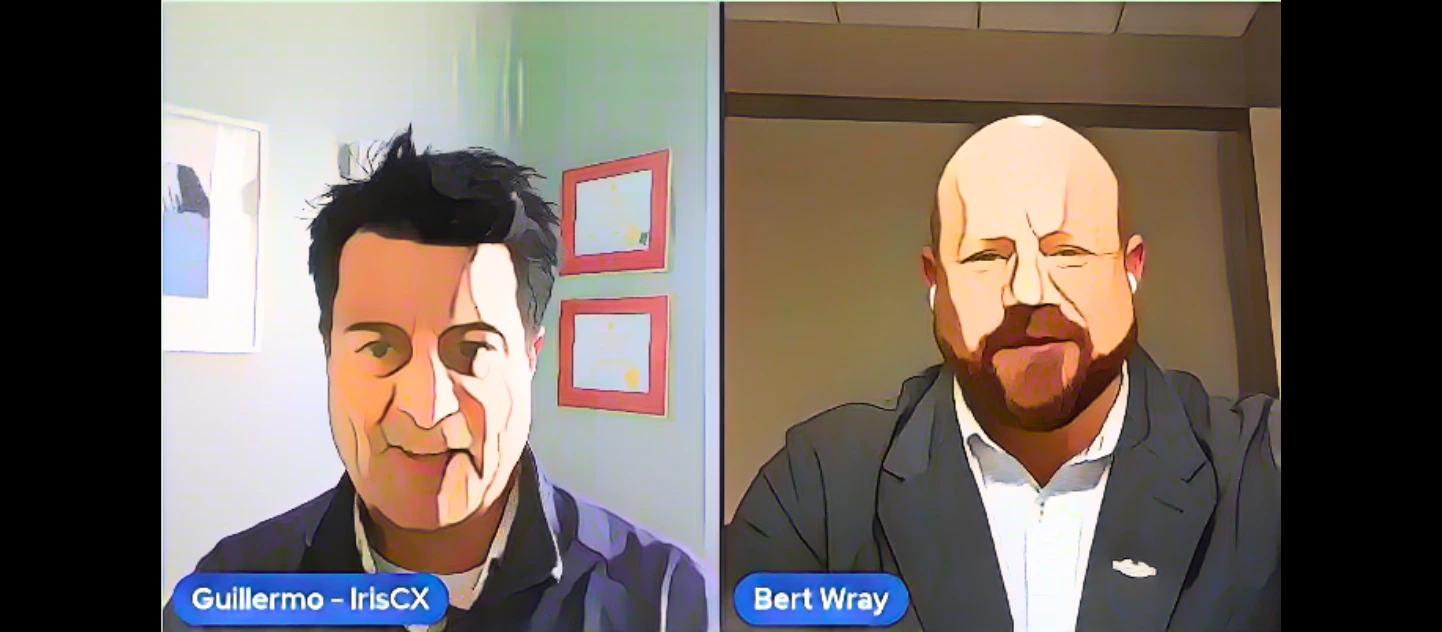
I’ve been trying to put words to something for a while now, and talking with Bert Wray helped me finally do it.
I first heard Bert on a podcast over a year ago, and something about his perspective stuck with me. Maybe it was the military background. Maybe it was the way he talked about operations with zero fluff. Or maybe it was how clearly he understood what most of the industry avoids admitting: we’ve been operating in emergency mode for so long that chaos feels normal.
When we finally connected—first briefly at OPTECH, then properly on Getting to Hell Yes—it became clear why Bert sees the industry the way he does. Bert’s perspective comes from infantry units, affordable housing portfolios, and now working at scale on the supplier side with Chadwell Supply. Not exactly your typical property management trajectory.
“I can’t improve what I can’t secure.”
Like most of us, Bert didn’t “choose” property management. It chose him.
After serving as an NCO in a mechanized infantry unit deployed to Iraq, Bert transitioned out of the military and into civilian life. A long-time personal training client introduced him to affordable housing, and suddenly he found himself managing an 11-property portfolio across two states.
What struck me wasn’t the career pivot. It was what carried over.
In the military, Bert learned this principle, and it still drives how he thinks about operations today.
He applied it directly to property management. Before you optimize, before you centralize, before you innovate—you have to stabilize. Safety. Predictability. Standards. And that same mindset followed him when he crossed over to the supplier side at Chadwell, where he now sees hundreds of operators up close, each with their own version of organized (or unorganized) chaos.
“If we only live in emergency mode, we don’t have room for a real emergency.”
Most maintenance teams don’t have emergencies. They live in them.
Poor planning creates urgency. Urgency creates stress. Stress destroys decision-making, and once everything is urgent, nothing actually is.
This hit hard because it explains so much. Burnout. Turnover. Budget overruns. Vendor frustration. Resident dissatisfaction. Emergency mode raises anxiety, increases costs, and eliminates margin—not just financial margin, but mental and operational margin. The space you need to think, to plan, to actually solve problems instead of just reacting to them.
And here’s the thing: suppliers feel this chaos last. When planning fails upstream, it lands downstream as a “need it now” order, often with the expectation that someone else absorbs the consequence of poor preparation.
“Can we talk about how to prevent this next time?”
He doesn’t start by lecturing customers about planning failures. He starts by solving the emergency. That’s how you earn the right to have the harder conversation later. Only after that does he ask this question.
That’s real partnership. No finger-pointing, no ego, no “that’s not my problem.” You solve it first, then you talk about preventing it. And Bert’s honest about learning this the hard way—push too early and you lose credibility. Earn it first, and customers invite you into the real conversation.
The cost isn’t the part. The cost is the downtime.
On paper, MRO supplies are commodities. A faucet is a faucet. A gasket is a gasket.
But Bert made a critical distinction most leaders miss: it’s not about what the part costs. It’s about the downtime created when the part isn’t there.
Every extra trip. Every delayed turn. Every resident waiting. Every tech who has to backtrack to identify a mismatched fixture. And nobody ever sees it on a report.
Standardizing something as basic as plumbing fixtures can save hours of labor per incident. But the moment one “value buy” sneaks in, the entire system fractures. Suddenly techs have to identify the brand, inventory doesn’t match, parts aren’t stocked, and repairs double or triple in time.
And the spreadsheet never shows it.
Actually—this reminds me of something else Bert said.
“Budget management isn’t maintenance management.”
He sees this constantly. Leaders hammering site teams on budget while unintentionally encouraging shortcuts that increase total cost.
Maintenance doesn’t drive financial outcomes directly. It creates operational conditions that drive financial outcomes. Underfund standards and you get more revisits, more downtime, more resident churn, more expense. You can’t spreadsheet your way out of broken workflows.
Data as the new currency (if you actually use it)
As Chadwell has scaled from 6 distribution centers to 27, Bert has seen data shift from “nice to have” to existential.
Fill rates. Delivery accuracy. Inventory signals. Warranty tracking. Rogue spend patterns.
One stat stood out: around 98% fill rate and a Net Promoter Score of 79. That doesn’t happen by accident. It happens by relentlessly doing what you said you’d do and measuring it.
But Bert was clear—data isn’t just for internal optimization. It’s how you change the conversation. Stop talking about savings. Start talking about expanded operating capacity. Not “I saved you money” but “I helped you do more with the same budget.” Operators get that. Savings is abstract. Capacity is real.
Doing this alone is now riskier than doing it together
COVID changed the industry—not just operationally, but culturally. Competitors started talking. Operators started sharing. Suppliers became partners. And that collaboration hasn’t gone away.
Bert sees it clearly: doing this alone is now riskier than doing it together. The margins are thinner. The pressure is higher. The tolerance for inefficiency is gone.
The winners won’t be the ones with the lowest prices. They’ll be the ones with the clearest standards, strongest partnerships, and best discipline.
What I’m still thinking about
Bert’s whole approach comes down to this: do the simple things consistently, and you’ll beat complicated every time. And “Hell Yes!” customers—the ones ready to change—aren’t looking for magic. They’re looking for partners who help them execute the basics better than yesterday.
Emergency mode is a symptom, not a badge of honor. Discipline beats innovation when chaos is high. Planning is a gift to your future self, and downtime is the real expense no one tracks.
Suppliers see patterns operators miss, if we listen. Data doesn’t create clarity unless we ask better questions. And collaboration is now a survival skill.
I keep coming back to that military principle: “I can’t improve what I can’t secure.”
You have to stabilize before you can do anything else.