Property management insurance requirements extend far beyond simply requiring tenants to carry renters insurance. They include understanding when that coverage fails and leaves you exposed.
The most dangerous gap appears during after-hours emergencies, when maintenance teams are under intense pressure to close tickets quickly and avoid $250-500 vendor dispatches.
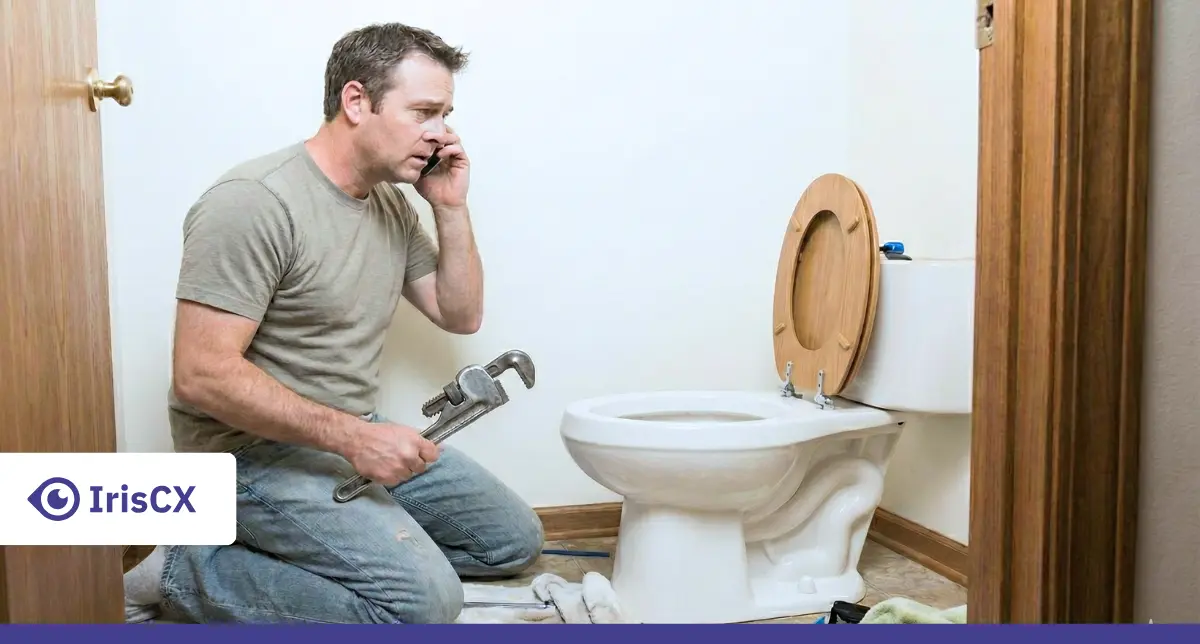
A resident calls at 11 PM about a toilet drip. Your team offers fast, remote troubleshooting via phone or chatbot: “Try tightening the supply line nut,” or “Turn the angle stop valve.” The resident follows your advice, applies too much force to an aging plastic component, and suddenly a minor drip becomes a major leak affecting the subfloor and the unit below.
When the damage claim arrives, here’s what property managers discover: landlord insurance vs renters insurance becomes a blame game where both policies point fingers, and your unrecorded phone advice becomes the liability.
The resident’s insurance denies the claim because their “actions caused the damage.” Your landlord insurance classifies it as resident negligence. And you’re left holding the bill, with zero documentation to prove your guidance was reasonable. This isn’t about whether the advice was technically correct. It’s about renters insurance proof, liability documentation, and the silent compliance gap that most operators overlook until it costs them thousands.
The Unrecorded Risk: High Cost, Zero Evidence
When troubleshooting relies on traditional, non-visual communication, you lose all control and verification, making the high cost of an after-hours claim almost inevitable if the repair goes wrong:
| Communication Method | Risk Implication | Evidence/Protection |
|---|---|---|
| Phone Call | The highest risk. No visual context, and no verifiable record of the exact advice given or the resident’s understanding. | Zero evidence. Reliance is purely on disputed testimony. |
| Basic Chatbot | Advice is text-based but is isolated from the work order system and lacks visual context. | Incomplete evidence. Shows text advice but not asset status or resident action. |
In the world of non-visual remote troubleshooting, the following outcomes frequently lead to the property manager absorbing costs:
- Misexecution: The resident follows correct advice but uses excessive force on an old plastic supply line, or twists the toilet base (potentially breaking the wax ring or flange).
- Misdiagnosis: The operator guesses wrong, advising a fix for the supply line when the actual failure is the fill valve or flange.
Any of these factors can escalate a drip into a major leak affecting the subfloor. The result is the same: the resident’s hands caused the damage while acting under management’s guidance.
| Liability Perspective | Determination | Cost Absorbed By |
|---|---|---|
| Rental Insurance | Resident’s actions caused the failure. | Policy claims denied. |
| Landlord’s Insurance | Classified as resident damage/negligence. | Deductibles and increased premiums. |
The Problem of Intervention Without Visual Access
Remote fixes fail because the critical context (the visual state of the asset) is missing, especially around a toilet where components are often plastic and highly susceptible to damage.
When you cannot see the issue, you are exposed to unpredictable risk factors:
- The age and material (plastic vs. copper) of the supply line.
- The integrity of the wax ring and flange (the most vulnerable components).
- The level of pressure or force being applied.
Unrecorded Advice + Non-Visual Execution = Uncovered Liability. The operator gets dragged into liability because the resident trusted the guidance that escalated the damage, and the manager has no auditable trail to prove otherwise.
The Solution: Visual Guidance as Liability Protection
The only way to close this liability gap is through visual verification and a permanent, integrated record. Seeing the problem transforms the risk dynamics, especially during high-cost after-hours calls:
- Accurate Diagnosis: The technician sees the precise component (e.g., confirming a loose coupling vs. a cracked tank).
- Controlled Guidance: The technician confirms the correct part and acceptable force, preventing dangerous improvisation near the base or supply line.
- Instant Escalation: The technician can immediately stop the resident and dispatch professional help if they see a crack forming or if the leak is coming from the base.
- Proof of Process: The visual recording of the guided intervention becomes definitive proof of a controlled, professional, and verified process, protecting the management team.
Visual triage shifts remote fixes from a liability risk (“Please don’t touch that”) to a verifiable, controlled process (“Here is exactly what to do, safely, while supervised”).
Call to Action: If your maintenance team is giving residents hands-on instructions without visual tools, they are accepting unnecessary risk to meet operational pressure. The speed you gain is not worth the liability you absorb.
Follow for more insights on reducing operational risk through proactive maintenance technology.