
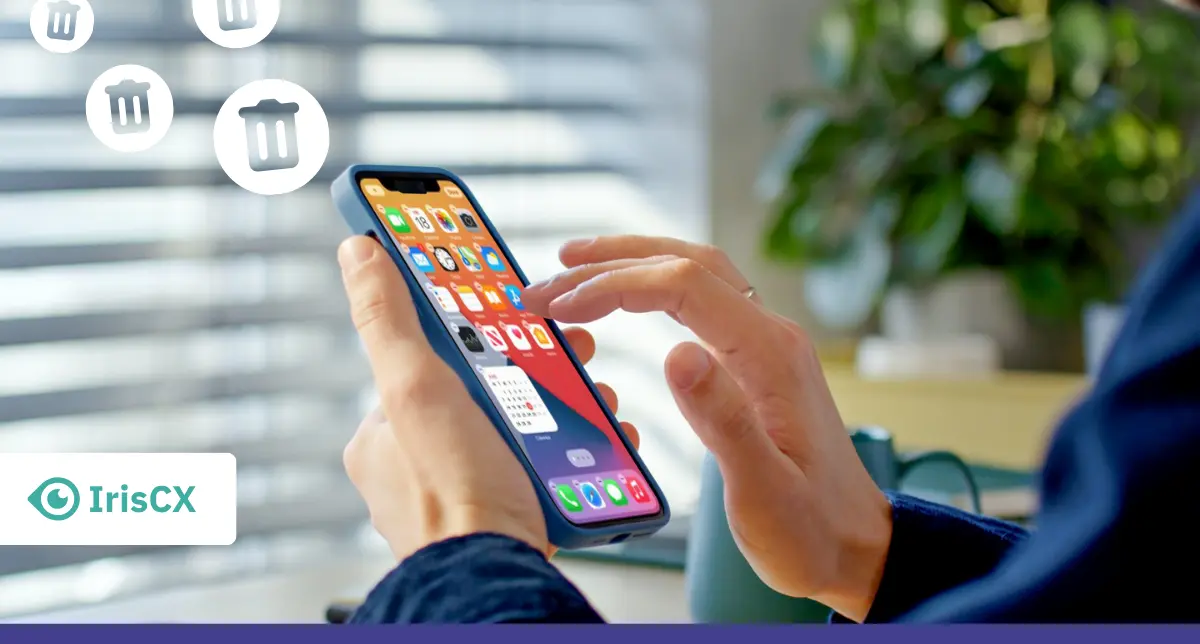
Property management software trends are shifting dramatically as we enter 2026, and a significant change is about eliminating friction.
App fatigue has reached a breaking point. Residents refuse to download yet another app, adoption rates stall, and operators waste thousands on unused subscriptions. The future of property management belongs to solutions that require zero downloads: SMS-based workflows, link-based access, and browser-native tools that work instantly.
This represents a fundamental shift in property management innovation, from “there’s an app for that” to “there’s a link for that.” Industry leaders are rethinking how maintenance requests enter their systems, moving away from app-dependent processes toward frictionless, instant-access solutions. The winners in 2026 will be the ones that make technology invisible.
The Origin Story: The App as a Constraint
The success of the App Store masked its true origin: constraint. When the first iPhone launched in 2007, Apple forbade native third-party apps, forcing developers into building limited web apps.
When the App Store debuted in 2008, it formalized this constraint, creating a lucrative development ecosystem. Developers built apps because Apple allowed it; users downloaded them because there was no better option. That system is now collapsing.
The App Tax: The Cost of Wasted Resources
The application model is inefficient – it demands friction and overhead that far outweighs the value delivered for non-daily tasks.
The “App Tax” includes:
- User Friction: Installation, mandatory updates, and the ongoing mental load of managing storage and learning new UIs.
- Budget Drain: The requirement to maintain dual native platforms (iOS and Android). This means allocating budget and engineering hours to:
- Separate development teams/stacks.
- Testing across multiple OS versions and devices.
- Managing two separate submission and approval processes.
This budget drain is the key failure. Resources spent managing two apps for a single experience could instead be invested in building one highly intelligent, core user experience (e.g., agent logic, seamless API integrations, or conversational flows).
Apps were built for a world where the user actively navigated software. That world is over.
The Replacement: Software as an Invisible Service
The alternative to the App Tax is a shift from software as a destination to software as an invisible service.
The browser and core operating applications are now powerful application layers providing incredible, instant experiences. This is driven by technologies like Progressive Web Apps (PWAs), which offer:
- Offline Functionality: PWAs can store significant data locally, providing the reliability of a native app even without an internet connection.
- Instant Access: They load instantly and bypass the download/update ceremony.
We will see more application access and capability delivered directly via plugins and extensions to core enterprise applications like Microsoft 365, Google Workspace, and Microsoft Teams. Point solutions should architect as a plugin, not as a monolithic core app.
The future replaces the command “open the app” with:
- Ask a question.
- Send a message.
- Trigger an action.
- Receive the result instantly.
The key to efficiency is less interface. It is a future defined by lightweight surfaces, conversational inputs, and instantaneous, invisible execution.
How Agents Quietly Killed the Home Screen Icon
Agents (or intelligent workflows) don’t need a UI. They ignore tabs and menus because they are designed purely around intent and outcome.
- Instead of navigating: “Pay this bill.”
- Instead of searching: “Book that flight.”
Agents won by stripping away friction: taps, menus, downloads, storage, and learning curves. They optimize on three simple dimensions:
- Instant Delivery: Outcome on demand.
- Low Footprint: No installation, no updates, no clutter.
- Low Frequency Support: Perfect for tasks that users perform once a month or less—tasks the current app model handles terribly.
The Toothbrush Test: Only Build for Daily Use
If you are still investing heavily in apps, you are designing a better piece of fax paper—polished, organized, but built for yesterday.
The Toothbrush Test: If a user does not need your product 1–2 times per day, it should not be an app.
This test eliminates most current app categories: Loyalty programs, account portals, scheduling, insurance, and property portals.
These should be actions, not destinations. If your product fails the Toothbrush Test, focus your resources on building:
- A conversational message interface.
- A system-integrated action or workflow.
- An agent integration (Slack, Teams, etc.).
People don’t want to visit your software; they want the job done and their time back.
Call to Action: Build for Pull, Not Presence
Stop dedicating resources to the static icon on the home screen. Stop funding the dual-platform tax. Start investing in the moment a customer needs something done.
The future doesn’t need a square on a phone. It needs responsiveness, speed, and intelligence—without the ceremony.
Apps had their run. 2026 is the year we admit that the future isn’t on the home screen. It shows up when you call it.
Questions for Discussion
For Product Owners (App Buyers):
- How much of your annual development budget is spent on maintaining parity between your iOS and Android versions versus developing new core features?
- For your low-frequency app (used monthly or less), what is the actual customer lifetime value benefit of forcing the user to download an icon?
For App Builders (Engineering/Dev Leads):
- If you rebuilt your app as a PWA and a simple API, how much developer time would be freed up from app store compliance and deployment friction?
For Users:
- How many apps on your phone could be replaced entirely by a simple text command, email reply, or agent integration?
- When was the last time you downloaded an app for a single-use task, only to delete it days later?