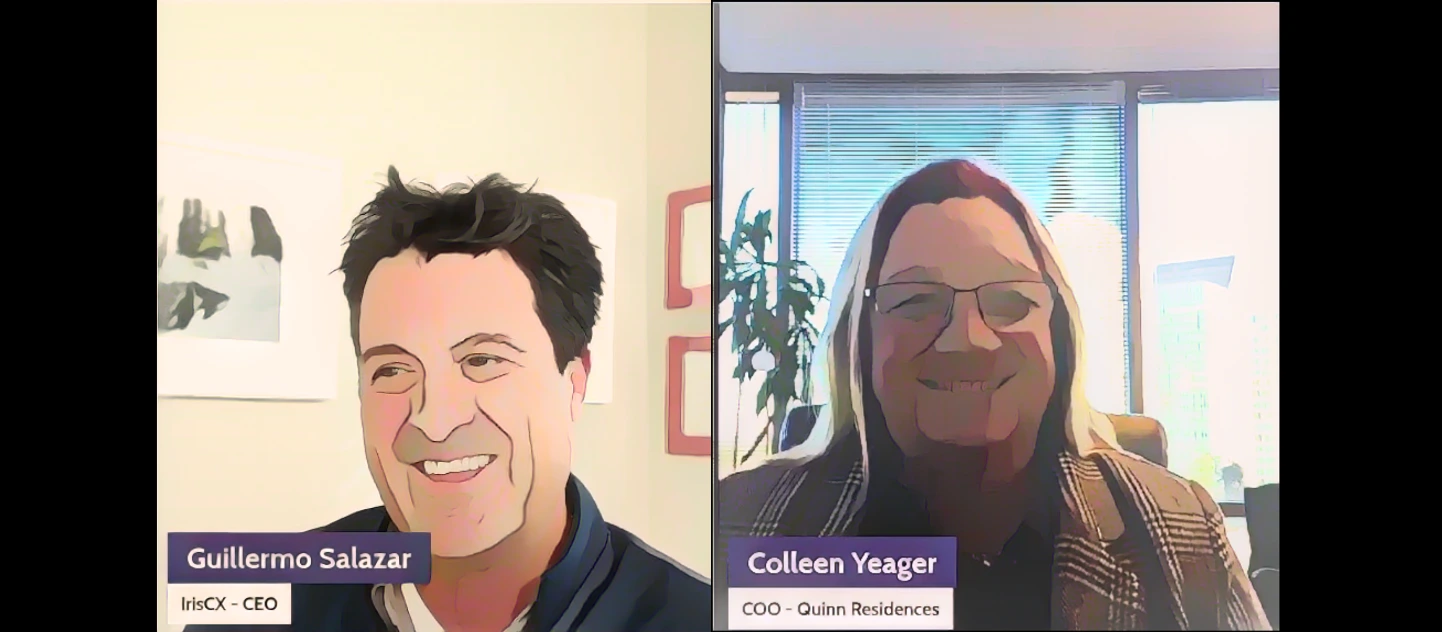
Colleen Yeager, Chief Operating Officer at Quinn Residences
On Building Build-to-Rent Communities From Dirt Up by Actually Asking What People Want.
Colleen & I were talking about how Quinn Residences decides what to build, and I’m expecting the usual answer about market research, competitive analysis, maybe some consultant reports. Instead, Colleen tells me this:
“I stalk residents. I’ll be visiting a community and see someone walking by, and I’ll just go, ‘Hey, how do you like living here?'”
Her team is mortified every time.
And there it is. The entire Quinn Residences playbook in one sentence: build what people actually want by having the audacity to ask them.
Not through surveys. Not through focus groups. Not through six layers of third-party management reporting filtered data up to ownership.
Ideo would call it observation & ethnography. Colleen calls it getting to know your customers.
Actual conversations. With actual residents. In their actual homes.
The COO Who Took a 99% Pay Cut (In Portfolio Size)
Colleen didn’t start in build-to-rent. Like most people in property management, she fell into it as a leasing consultant in college, moved through Trammell Crow, spent years at Equity Residential learning from what she calls “amazing teachers and leaders.” Then she moved to Invitation Homes, where she was running 6,500 scattered single-family rental homes.
Six thousand five hundred homes.
Then Richard Ross came knocking in 2020 with an offer that makes absolutely no sense on paper: come build a build-to-rent company. From scratch. Starting with thirteen homes.
“We’re building communities,” Richard told her. “Not apartments. Not multifamily. Rental communities. From the dirt up.”
Colleen’s response?
“Hell yeah, let’s do it.”
Because here’s what made the opportunity impossible to resist: Colleen’s father was a general contractor. She grew up on construction sites. She’d done construction work with Equity Residential and loved that side of the business. And Richard was offering her something almost nobody in property management ever gets.
Control over the product itself.
I Chase Publix
Colleen’s first year at Quinn? “All I did was fly around and look at dirt.”
She’d land in some market, drive out to a site, and call back to Douglas and the acquisitions team with one of two messages: “Are you all crazy? There’s cows everywhere” or “Wow, this is a home run. It’s twenty minutes from Charlotte.”
Her metric for site selection is beautiful in its simplicity: “I chase Publix.”
When Starbucks and Chick-fil-A built after Quinn’s Drayton deal in Pooler, Georgia near Savannah that’s when she knew they’d picked the right spot. “That’s when you know you built in the right spot,” she tells me.
Four years later, Quinn Residences has grown from thirteen homes to around five thousand. They’ve got fourteen properties in their core portfolio either stabilized or headed into same-home status for 2026. And they’re building everything themselves, from acquisition to construction to management.
Because that’s the other part of what makes Quinn different.
Nobody Manages Better Than an Owner
“I respect third-party management teams,” Colleen says, “but I will say nobody manages better than an owner.”
This isn’t shade. It’s structural reality.
When Quinn internalized management, they gained something most owners never get: unfiltered visibility into their data, their demographics, what residents were looking for, and critically what they weren’t looking for.
“You ask a resident what they need and they’re not shy. You just have to listen and make those decisions around that.”
This is where most build-to-rent operators and honestly, most real estate operators period miss the entire point.
They build what they think residents want. Or what the market study says residents want. Or what the competitor down the street is offering.
Quinn builds what residents tell them they want. Then they iterate based on what residents tell them isn’t working.
The difference is everything.
The Beta Test Living in Your House
Here’s how Quinn’s product development actually works.
They start with a new community. Maybe they try something they haven’t done before: covered parking, different floor plans, a new amenity configuration. And then they watch what happens.
Colleen loves visiting properties under construction. Not because she’s checking quality though she is but because she can see resident reactions in real-time. “If I want to add something different or change something different, it’s kind of like a beta test in your house. It might work, it might not, but we’re able to test it.”
This is the advantage of building from dirt up with full operational control: you can experiment at a pace that would be impossible if you were stuck in the traditional owner/third-party manager dynamic.
Two-car garages? Non-negotiable. They learned that from resident feedback.
Properties that mix single-family homes and townhomes? One of Colleen’s favorite configurations because it gives residents price points and options on the same property.
Pet-friendly with well-designed pet amenities? Essential, because 75% of Quinn’s residents have pets.
None of this came from market research. It came from actually talking to the people who live there.
The Data You Can’t Get From a Dashboard
What fascinates me about Colleen’s approach is how it mirrors building technology products more than traditional real estate operations.
In software, there’s a concept called “getting out of the building” talking to actual users instead of relying on usage data or surveys. The best product managers spend absurd amounts of time watching people use their products, asking questions, and understanding context.
That’s exactly what Colleen does with Quinn’s communities.
“I love being out in the field,” she tells me. “Let me be out in the field because you learn so much from the teams. They love to talk to you. It hypes me up so much. I love visiting communities and talking to the teams on site.”
She’s not checking boxes. She’s not doing site inspections. She’s learning.
From the team about operational challenges, workflow bottlenecks, what’s working and what isn’t.
From residents about why they chose Quinn, what they love, what frustrates them, what they wish was different.
And here’s the kicker: the information you get in person is different from what you get over Zoom or through surveys.
“In person is different,” Colleen confirms. “You get different information when you’re in person than when you’re over [the phone]. Too many people hide behind the keyboard. Go have a conversation.”
The Objection That Isn’t
When I ask Colleen what objections they get from prospects who don’t choose Quinn, her answer reveals how well they’ve nailed product-market fit.
“Usually it’s availability of what they’re looking for,” she says. Not price. Not features. Not competition. Availability.
Someone walks into a property and Quinn only has two homes available. One is a four-bedroom where the bedrooms are too small for their needs. The other is a townhome but they wanted a single-family. Or they need a two-car garage and the available unit doesn’t have one.
“I can’t imagine somebody walking into one of our homes and other than availability, them not wanting to rent with us,” Colleen tells me.
That’s not arrogance. That’s confidence that comes from knowing your product works because you built it based on direct feedback from the people who use it.
The Biggest Lesson
“I don’t think I was in tune with customer demands. I really don’t. I think over the last ten years, I have probably heightened my awareness of: listen to your customer. They tell you how to be successful. They do.”
She pauses, then adds: “And listen to your team.”
“You learn a lot by listening. That’s been my biggest lesson over the last decade.”
This is the insight that separates operators who scale from operators who stall.
Most property management companies optimize for efficiency. Faster turns. Lower operating costs. Better margins. All important, obviously.
But Quinn optimizes for learning. They’ve built a system where customer feedback and team insights flow directly to the people who can actually change the product.
That’s only possible because they own the entire stack: acquisition, construction, management, operations. There’s no third party filtering information. No six-month delay between “residents want this” and “we can build that.”
When Colleen learns something from stalking a resident or talking to an on-site team, that insight can influence the next building they break ground on.
That’s a competitive advantage you can’t buy with better software or higher marketing spend.
From My Side of the Mic
What gets me about Colleen’s story is how deceptively simple it all sounds.
Talk to residents. Listen to your team. Build what people actually want. Iterate based on feedback.
It’s not rocket science. It’s not even particularly innovative as a concept.
But here’s the thing: almost nobody does it. In real estate, in technology.
Most real estate operators are three or four layers removed from their actual customers. Third-party management creates a buffer. Regional structures create another buffer. Corporate offices create a third buffer. By the time resident feedback reaches the people making product decisions, it’s been filtered, aggregated, and sanitized into uselessness.
What Quinn has built and what Colleen has architected as COO is a feedback loop with zero intermediaries.
The customer tells the team. The team tells Colleen. Colleen tells Richard and the construction team. The next property incorporates the insight.
That’s it. That’s the whole playbook.
But executing that playbook required something most operators aren’t willing to do: internalize everything. Take on the operational complexity. Own the entire stack from dirt to resident experience.
When Colleen says “nobody manages better than an owner,” she’s not wrong. But she’s also not talking about management in the traditional sense checking work orders, processing applications, handling maintenance.
She’s talking about having skin in the game. Caring about the outcome enough to actually listen. Being close enough to the product to iterate quickly when something isn’t working.
That proximity is what enables everything else.
And honestly? It’s what the entire industry is missing right now.
We’ve spent the last five to seven years optimizing for operational efficiency. Centralizing functions. Automating workflows. All in service of better margins.
But somewhere along the way, we lost the connection to why people actually choose to live in our communities.
Colleen’s approach brings that back. Not through more surveys or better data dashboards though Quinn uses both. Through actual human conversation. In person. On site. At the moment.
When she says she spent the past year learning from listening, that’s not a soft skill. That’s the core competency that’s allowed Quinn to grow from thirteen homes to five thousand in four years.
Because when you actually know what your customers want, not what you think they want, not what the market study says, not what your competitor is offering you can build something they’ll choose every time.
And when the main objection you hear is “we don’t have the exact home available that I want right now,” you’re not competing on price or features anymore.
You’re competing on availability.
Which means the only constraint to growth is how fast you can build.
That’s not a problem. That’s a gift.
Don’t Miss This Conversation
If you’re building a build-to-rent portfolio and wondering why your product isn’t resonating… if you’re in the third-party management dynamic and frustrated by the distance from your residents… if you’ve ever thought “we should just talk to our customers more” but don’t know how to make that systematic…
This conversation with Colleen Yeager is your playbook.
Watch the full episode to hear Colleen break down exactly how Quinn’s internalized management model creates competitive advantage, why being on-site teaches you things no dashboard ever will, and what you learn when you have the audacity to stalk residents and ask them how they actually like living in your communities.
You’ll learn why “chasing Publix” is a better site selection strategy than most consultants will ever give you, how to beta test new features in real homes with real residents, and why the biggest lesson of the last decade has nothing to do with technology or efficiency and everything to do with learning from listening.
The episode is live now.
Because here’s the truth: you can have two identical units, but the one with better operations, the one where someone actually listens to residents and iterates based on what they learn, that’s the one that rents. That’s the one that keeps residents. That’s the one that drives NOI.
Which side of that gap do you want to be on?