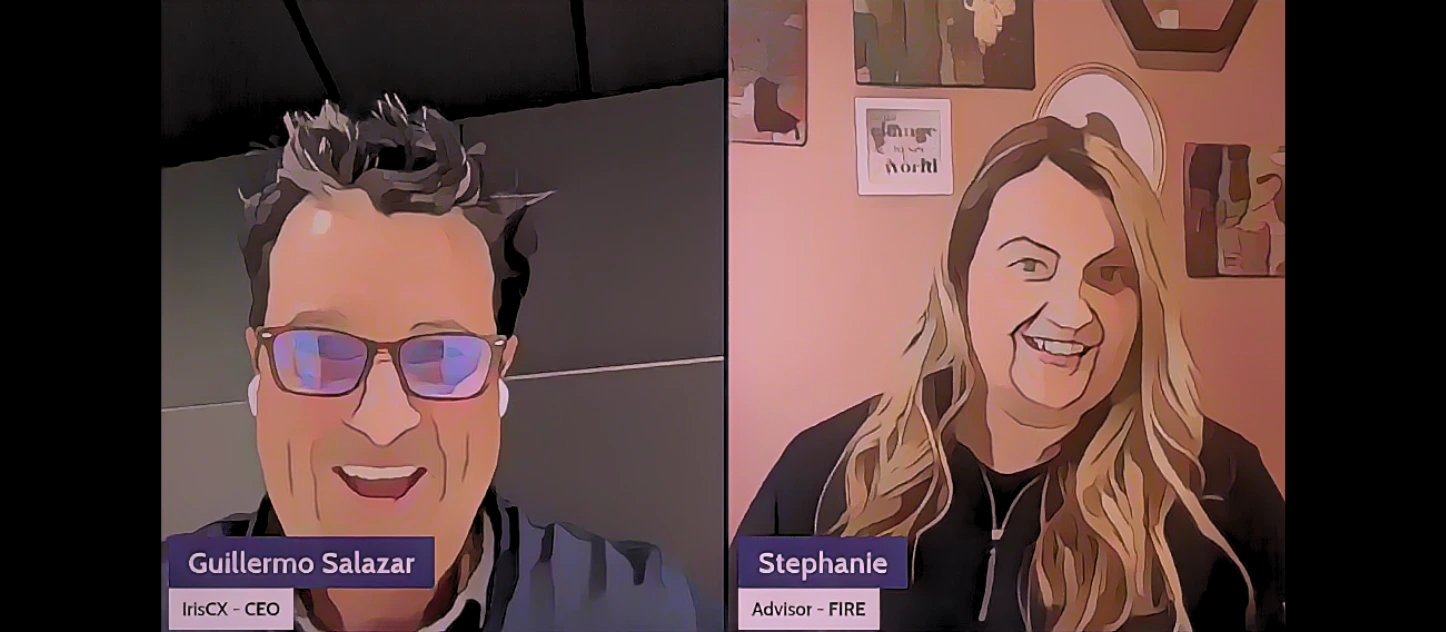
Stephanie Gubiotti, Advisor at FIRE (Foundation for Innovation in Real Estate) On Building the Career Path That Property Management Forgot to Create
Near the end of my conversation with Stephanie Gubiotti, I asked her what advice she’d give her younger self.
Her answer stops me cold. “I wish I had thicker skin earlier.”
She pauses. “I’m still you know, I’m soft-hearted. But that’s probably why working at a nonprofit is so good for me.”
And there it is. The vulnerability that makes this conversation different from every other prop tech, career development, or industry advancement discussion I’ve had.
Because here’s what I realize as Stephanie says this: if she’d had thicker skin, she wouldn’t be sitting here building FIRE. She wouldn’t be leading the Emerging Manager Tech Council with 650,000 units under their umbrella. She wouldn’t be the person who sees a maintenance supervisor burned out from being the only one on call and thinks, “We have to fix this systemically.”
Thicker skin would have made her less effective at the exact thing she’s built her career to do.
The Leasing Associate Who Saw the Whole Game
Stephanie started where so many in this industry start: as a leasing associate. But unlike most, she didn’t just see the leasing function. She saw the system.
“I worked my way up through the industry across operations and technology, across multiple well-respected real estate investment firms,” she tells me. That journey from boots-on-the-ground to strategic advisor gave her something most people in property management never get: perspective on how all the pieces fit together.
Or more importantly, how they don’t.
Now she’s an advisor to FIRE, leading their Emerging Manager Tech Council. The portfolio includes not just multifamily but hospitality, commercial retail, and medical properties. “Having all of those different areas in the built world,” she explains, “because our concept is that we will have resources to help people.”
Resources. That word comes up again and again in our conversation. Not software. Not platforms. Not solutions.
Resources.
“We are a 501(c)(3). We are fully registered as a nonprofit. And we do other areas as well. The emerging manager tech council is how we kind of play in the sandbox, get technology moving along faster. Speed to decision is very important to us.”
But here’s what makes FIRE different from every conference, every membership organization, every industry group: they’re not trying to make money off the problem. They’re trying to solve it.
The Problem Nobody Owns
“It’s kind of like everybody’s problem, but no one’s problem,” I say in my opening. Stephanie doesn’t disagree.
The gap is everywhere. Career paths are murky at best, nonexistent at worst. The leasing-to-APM-to-PM-to-regional track used to be predictable. Now? “Operational didn’t really have a career path at all,” I point out. Maintenance is evolving because of centralization, but what does progression actually look like?
And here’s the kicker: everyone falls into this industry.
“I don’t think I know anybody that was like, I’m going to be in property management when I grow up,” Stephanie laughs. “We all kind of fall into it and we go along the way.”
I share the Chelsea Knealand story on how she got recruited from retail because she had “a great smile.” Stephanie immediately relates: “I have certainly hired many people when I go to check into a hotel. Would you like a job in the real estate space? We have better hours in the real estate space than the hotel space.”
But falling into an industry is one thing. Building a career in it is another.
And that’s the infrastructure FIRE is building.
“We want people who think like us and people who want to give back. And I can certainly speak for myself. I wouldn’t be here in my career if I didn’t have leaders along the way who were very giving and who really showed that level of philanthropy.”
Four Stakeholders, One Ecosystem
What Stephanie has architected at FIRE is elegant in its simplicity: bring together the four groups who can actually solve the talent crisis.
1. Industry Veterans – People who’ve been in the industry long enough to see the gaps and have the resources to help close them.
2. Emerging Leaders – The minus-two-to-five-year career folks. People who haven’t even chosen property management yet, all the way through their first five formative years.
3. PropTech Companies – The technology partners who want to solve problems but can’t find innovative operators willing to experiment with them.
4. Capital – LPs and GPs who understand that talent infrastructure is investment infrastructure.
“Those four groups can kind of make anything happen,” I point out. “You’ve got the steering, the horsepower, the problem, the roadmap.”
But getting four different stakeholder groups to agree they’re either complicit in the problem or attributable to solving it? That’s the hard part.
Stephanie’s answer is refreshingly direct: “Finding like-minded people and people who have that philanthropic mindset and want to give back and see that there’s a broader picture.”
Not everyone needs to donate to FIRE specifically. But everyone should be giving back somewhere. “It’s good for personal wellbeing. It’s good for your organization to have a philanthropic approach.”
The Differentiation That Actually Matters
When I push Stephanie on why someone would choose FIRE over the dozens of conferences and industry events competing for their time and money, her answer reveals the fundamental misunderstanding most organizations have about value.
“We are, because we’re a nonprofit, we are neutral in space. We play well in the sandbox with everybody. We’re not going to charge you differently because you’re a supplier partner versus an operator. We are people together collaborating in this industry.”
But it’s the specifics that matter:
Academia Programs – Going to campuses, working with students, creating the talent pipeline before people even know property management exists.
Job Board – Connecting opportunities across real estate and prop tech to help people navigate transitions.
Mental Health Resources – Four therapists or coaches available specifically for founders, because “being a founder is very lonely” and “the barrier to kind of getting into this industry is pretty hard.”
Robotics Program – Donors purchase space at events so robotics companies can showcase technology they’d never otherwise have access to.
Free Conference Tickets – For emerging managers who can’t afford the $2,000-3,000 price tags that major conferences command.
“We can help you with things that you probably don’t even know that you need help with and prevent you from making mistakes that we have seen people make because within our group and our ecosystem, we probably know somebody who has gone through what it is that you’re going through.”
This is the outsourced Chief Innovation Officer model. Speed to decision without the full-time headcount and turnover risk.
The Gap That Keeps Stephanie Up at Night
When I ask what happens if we don’t fill the emerging leader gap, Stephanie doesn’t sugarcoat it.
“People will spend a lot of money being frustrated in space because they’re not able to, technology partners aren’t able to find innovative operators who are willing to play in the sandbox with them in order to be able to advance.”
But it’s deeper than that.
“There’s going to be a lot of vacancies. That leads to poor resident retention. It leads to the assets not being maintained well enough in the ways that they should be. And it also leads to your good people being burnt out.”
She paints a picture I’ve heard too many times: a property short-staffed, one excellent maintenance supervisor carrying the entire load. They’re the only ones taking on-call. The weight is crushing.
And then there’s the invisible crisis nobody talks about: exit transitions.
“The way that we exit within prop tech and real estate is just as important as the way that we come into space. When you sell your property and all of those team members may or may not have a job again, that’s something that is a really big gap in the industry.”
Think about it. A small-to-mid-sized owner-operator sells a property. The site team lives on-site. Maybe they’re not offered positions with the new owner. Suddenly they’re changing health insurance, possibly paying COBRA, starting over with a brand new company.
“I’ve seen a lot of people actually leave the industry because they’re like, yeah, I don’t want to go through that again. It’s too risky.”
That’s not a talent problem. That’s a system design problem.
The Maintenance Gap Nobody’s Solving
One of Stephanie’s most passionate moments comes when she talks about the skilled trades gap.
“There is a lot of skill gap in what we have kind of coming in. I think that if we were able to, via the nonprofit, work with people before they’re even in college, maybe we get them introduced to a trade school, maybe we get them some facilities type training.”
Because here’s the reality: “We are all going to need plumbers. We’re all going to need electricians. We are all going to need our facilities. They are critical. And I would argue it’s probably the most critical role in the property operations ecosystem because they are so intertwined with your residents day in and day out.”
Her vision? Owners donating internships plus paid apartments for six months for someone who doesn’t have resources. “That’s how we’re going to be able to tangibly make a difference in somebody’s life because we’ve given them resources and access and connections plus education.”
Cross-collaboration between owner-operators and prop tech to build the boots-on-the-ground talent pipeline.
Because right now? “It’s not always known about the industry. Most people don’t say, I’m going to be in property management when I grow up. ” We all kind of fall into it.”
The Technology Decision Nobody Understands
Here’s where Stephanie’s operator experience becomes invaluable.
“I saw over and over and over in my career people making technology choices and decisions that they didn’t understand the implications of and how that could affect their business.”
She lists examples that make my head spin: “If you’re rolling out a brand new property management system, why is it so important to be able to have that data migration? Do you know about lease documents and merge fields? Do you understand that if you’re implementing a new CRM that needs to talk to your revenue management system and how that’s going to show up on your websites? How is that going to interact with your AI bot?”
None of this existed five years ago. Now it’s table stakes.
And when things go wrong? “Your website goes down, you’re not leasing. Let’s just say the average vacancy loss, let’s call it fifty dollars a day. It adds up.”
“The amount of change management that we’re able to help people avoid the bumps and bruises through is worth a donation all day long.”
This is why the emerging manager tech council exists. To close the gap between what operators know they need and what they don’t know they don’t know.
From My Side of the Mic
What gets me about Stephanie’s approach is the ruthless clarity about what actually matters.
This isn’t about conferences. It’s not about networking events. It’s not even primarily about technology, though technology is the catalyst.
It’s about infrastructure.
Career infrastructure. Knowledge infrastructure. Support infrastructure. Exit infrastructure.
And here’s what I keep coming back to: Stephanie’s “soft heart” isn’t a liability. It’s her superpower.
When she says, “I wish I had thicker skin earlier,” my immediate response is: “You might not be where you are today if you had a thicker skin.”
Because thicker skin would have meant caring less. It would have meant accepting the gaps as “just how the industry works.” It would have meant not lying awake thinking about the maintenance supervisor who’s burned out or the site team facing COBRA because their property was sold.
Stephanie’s ability to “really sit with people when they’re going through hard things” and “connect with them in a way that not a lot of people can” that’s not a weakness. That’s the exact trait required to build what FIRE is building.
You can’t create meaningful career infrastructure for an industry without caring deeply, personally, vulnerably about the people whose careers hang in the balance.
Stephanie isn’t solving a market opportunity. She’s solving a human problem that happens to have massive market implications.
Because if we don’t solve the emerging leader gap, the whole ecosystem suffers. Asset values decline because properties aren’t well-maintained. Resident retention craters because good people burn out and leave. Technology adoption stalls because operators don’t understand implementation risks.
The entire industry becomes unsustainable.
What FIRE is building. What Stephanie is personally building through sheer force of caring too much is the opposite of that death spiral.
It’s a flywheel where industry veterans invest in emerging leaders, who partner with prop tech companies, who attract capital, which funds more veteran involvement, which educates more emerging leaders.
It’s elegant. It’s needed. And it absolutely required someone who takes things personally to architect it.
So when Stephanie says she wishes she’d had thicker skin, I hear what she’s really saying: “I wish growing into this role had hurt less.”
Fair.
But the hurt? That’s the price of building something that matters. And what Stephanie’s building matters more than most people in this industry realize.
Because talent isn’t a nice-to-have. It’s not an HR problem or a recruiting challenge.
It’s the entire foundation upon which every real estate transaction, every technology deployment, every resident experience rests.
And foundations require people who care enough to build them right.
Even when, especially when it hurts.
Don’t Miss This Conversation
If you’re an emerging manager trying to figure out where your career goes from here… if you’re a veteran operator wondering how to give back… if you’re a prop tech founder struggling to find innovative operators willing to experiment… if you’re watching talent walk out the door and wondering how to stop the bleeding…
This conversation with Stephanie Gubiotti is your blueprint.
Watch the full episode to hear Stephanie break down exactly how FIRE’s ecosystem works, why the exit transition crisis is killing retention, and what it actually takes to build career infrastructure in an industry that’s forgotten how to develop talent.
You’ll learn why being “soft-hearted” is the exact trait required to solve hard infrastructure problems, how four stakeholder groups can collaborate without competing, and why the maintenance skills gap might be the most critical challenge facing property management today.
The episode is live now.
Because here’s the truth: someone is going to build the talent pipeline for this industry’s future. Someone is going to create the career paths that turn accidental leasing associates into strategic leaders.
The only question is whether you’re going to be part of building it or part of the problem that made it necessary.
Which side of that infrastructure do you want to be on?