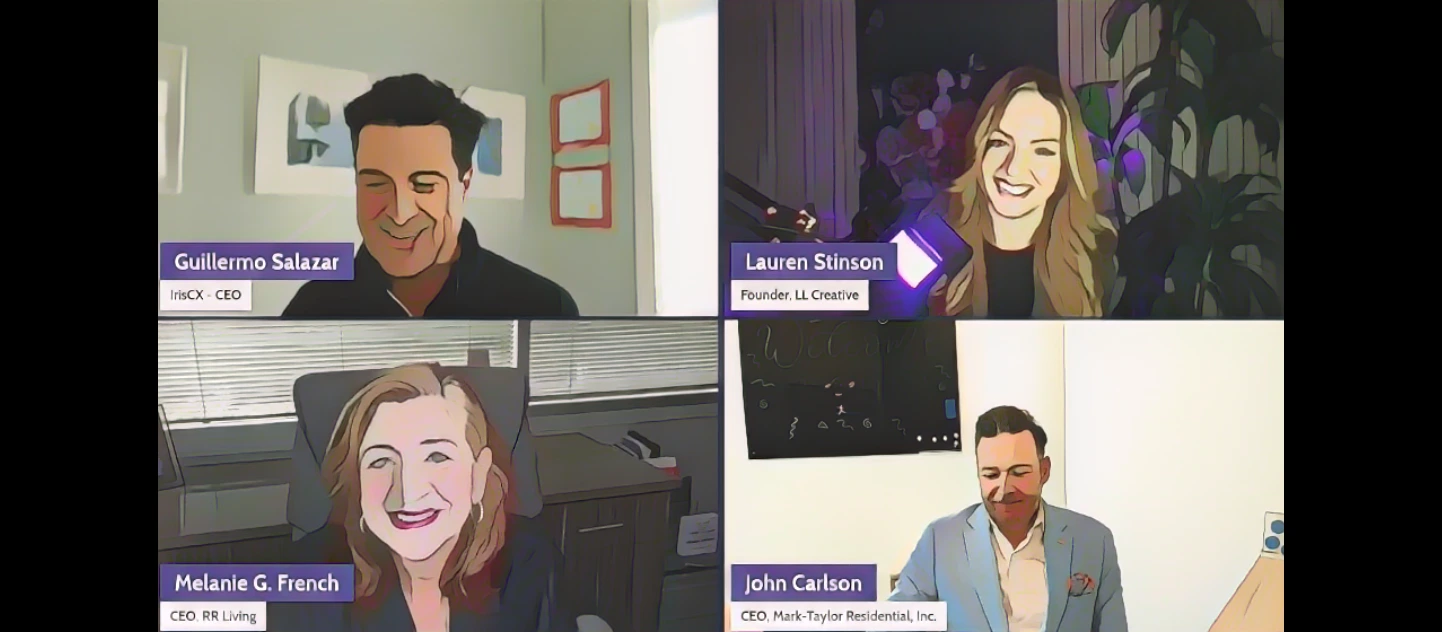
Lauren Stinson (LL Creative), Melanie French (RR Living), John Carlson (Mark Taylor) On Why Brand Isn’t What You Think It Is
There’s a question that keeps coming up at industry conferences, in LinkedIn posts, and in boardroom conversations: “What’s your brand?”
And according to Lauren Stinson, founder of LL Creative, most people have no idea what they’re actually talking about.
“Both Lauren and I were chatting, does anyone know what they’re talking about? They’re talking about this stuff, what this means, what this implies when you talk about brands so broadly,” I tell the panel as we kick off this conversation.
That’s why we brought together three people who’ve actually built brands that matter: Lauren Stinson, CEO of LL Creative; Melanie French, CEO of RR Living; and John Carlson, CEO of Mark Taylor and host of the Multifamily Forward podcast.
This isn’t a theoretical discussion about logos and taglines. This is about the hard work of aligning personal reputation, company values, and customer promises into something that actually wins business.
The Three-Part Framework
Before we dive in, let me level-set on what we’re actually talking about when we say “brand.”
Personal Brand: Your individual reputation. What people say about you when you’re not in the room. You don’t get a vote in this you can influence it, but ultimately it’s what people believe about you. It’s portable. It follows you from company to company.
Company Brand: What the organization stands for. Its reputation, values, why people choose you as employees, customers, or stakeholders. Technically, it’s the value of the firm minus the net book value of its assets. That gap? That’s brand value.
Brand Promise: The specific commitment you make to the market. This is where personal brand and company brand intersect. It’s what people actually buy.
Where it gets complicated is when these three elements are muddy or, worse, incongruent with each other. That’s when people start making guesses. And those guesses create uncomfortable environments and missed opportunities.
When One Plus One Equals Three
I start with a direct question: “Tell me about a time when your personal brand and your company’s brand amplified each other. A one plus one equals three scenario. How did it help you win work?”
Melanie goes first: “I think there are several times in my career where the company benefited from my brand, I benefited from the company, and the two then kind of multiply and take on a much bigger picture. One of those would be when I had joined Cortland. At that point, it was a much smaller organization. So together, we built out that property management firm where we put the customer first and we really put the quality first. And as the head of the organization, that of course started with me, but it ended with every single team member: your porters, your groundskeepers, your housekeepers. I’ve been incredibly pleased to watch through the years how large that organization has grown.”
What strikes me about Melanie’s answer is the cascade effect. It started with her personal commitment to quality, became embedded in the company culture, and eventually touched every single role in the organization.
John’s perspective is different but equally powerful: “A bit unique for me with being at Mark Taylor for twenty plus years and leading the organization today I would say that myself in terms of my brand really merges together with our organizations.”
He shares his personal purpose statement: “To empower, support and unify our culture so that someday each employee will love Mark Taylor as much as I do.”
“I say this to every new hire group on Monday,” John explains. “And the challenge for me is to ensure they’re following our vision, our mission, and our principles. We have five principles: be transparent, be better than yesterday, choose the right attitude, do the right thing, take extreme ownership.”
Here’s the habit: “I live by that code personally and professionally. And I always challenge my employees to think the same. Day one, I challenge them to at least incorporate one principle into their personal life. The idea being that eventually it’s a flywheel effect they start operating in that mindset personally that feeds into their professional life.”
“When your employees start living by those principles,” John continues, “that’s a flywheel effect in terms of your customer and your clients. I believe that we’re creating a five-star employee experience, which translates into both client and customer. I challenge anyone to say I can create a five-star customer experience without first having a five-star employee experience.”
This is the part most companies miss. They try to manufacture customer experience without investing in employee experience. It doesn’t work.
The Personal Brand Paradox
Lauren brings up something fascinating: “You don’t control your brand.”
She’s right. Your brand is what people say about you when you’re not in the room. You can influence it, shape it, amplify it but you don’t control it.
“A brand is a living, breathing organism that changes and morphs every day,” Melanie adds. “But it’s yours to lose.”
I push the group on something I’ve been thinking about: “When does personal brand become problematic for company brand? When does incongruency create friction?”
John responds thoughtfully: “I don’t think it’s problematic unless the individual’s values and character are different from the organization’s. If you’re aligned in values and you have solid character, then I think your personal brand only elevates the organization.”
But here’s where it gets nuanced. John continues: “Now, if you’re misaligned in values or your character is off, that’s when it becomes problematic. And I think that’s where a lot of organizations struggle; they haven’t clearly defined their values, so they can’t identify when someone’s misaligned.”
Melanie shares a powerful story about this exact challenge:
“I had a situation where we had a team member who was incredibly talented, had a strong personal brand in the industry, but their values were completely misaligned with our organization. And it created this weird tension where externally people would associate us with this person’s reputation, but internally it was causing massive cultural problems.”
“The hardest decision I had to make was letting them go,” Melanie continues, “because on paper they were performing. But the damage to our internal culture and the confusion it created about what we actually stood for wasn’t sustainable.”
This is the incongruency problem in action. When personal brand and company brand diverge too far, something has to give.
The Testimonial That Changed Everything
One of the most interesting parts of our conversation is when we discuss how a brand actually wins business in property management.
John shares a story: “We had a client who was evaluating three different management companies. On paper, we weren’t the cheapest. We weren’t the biggest. But they chose us because of one thing: a testimonial from one of our employees.”
“This employee had been with us for eight years,” John explains. “Started as a leasing consultant, worked her way up to community manager. And in this testimonial, she talked about how Mark Taylor had invested in her growth, believed in her when she didn’t believe in herself, and created an environment where she could thrive.”
“The client told me later: ‘If you can create that kind of loyalty and growth in your employees, I trust you’ll do the same for our residents,'” John recalls.
That’s the brand working exactly how it should. The employee experience becomes the proof point for the customer experience.
Melanie has a similar story: “We were pitching a high-profile asset. Luxury. Competitive market. And in the middle of the presentation, one of the owners pulled me aside and said, ‘I’ve been watching how your team interacts with each other. The respect, the collaboration, the energy. That’s what I want for this property.'”
“We won that deal not because of our pitch deck,” Melanie says, “but because our brand promised our commitment to quality and people were visible in how we showed up.”
The Five-Star Experience Hierarchy
John introduces a framework that resonates immediately: “I challenge anyone to say I can create a five-star customer experience without first having a five-star employee experience. You can’t do it. It’s impossible.”
He breaks it down: “If you want five-star customer experience, you need five-star employee experience first. And to get five-star employee experience, you need clarity on values, investment in people, and leaders who actually live those values.”
I connect this to something I’ve been seeing: “The companies that are winning right now especially in this choppy market aren’t the ones with the biggest marketing budgets. They’re the ones with the clearest values and the most engaged employees.”
Lauren adds: “And the interesting thing is, you can’t fake that. Residents can tell. Clients can tell. The market can tell. If your employee experience is two stars, no amount of marketing is going to convince people you’re delivering five-star resident experience.”
Humanize the Exceptions, Automate the Rest
John shares a principle that becomes a theme for the entire conversation: “Humanize the exceptions, automate the rest.”
“What I mean by that,” John explains, “is that there are certain things that should be standardized, automated, and made as efficient as possible. Accounts payable. Work order routing. Lease renewals at standard terms. Make those seamless.”
“But then there are the exceptions,” he continues. “The resident who’s going through a divorce and needs flexibility on their lease. The employee who’s dealing with a family crisis. The client who has a unique concern. Those are the moments where you show up as a human being, not as a process.”
Melanie jumps in: “And the brand promise is really about what you do in those exception moments. Anyone can follow a process. Not everyone can show up with empathy, judgment, and care when the situation doesn’t fit the script.”
This is the brand differentiation that actually matters. Not your logo. Not your tagline. How you handle the moments that don’t have a playbook.
The Pivotability Advantage
Lauren introduces a concept that shifts the conversation: “I think a lot of people think we’ve locked in our brand. And I can’t stand that a lot of times a brand is just tied to your logo and your look. But at the same time, your actual brand I think pivotability, especially when you’re able to test and grow and learn in a more condensed environment, that is your edge.”
“Let your marketplace tell you what you need to be doing,” Lauren continues. “Learn, and then scale. I think pivotability is really important, especially in those early stages.”
I build on this: “For that pivotability to occur, you’ve got to have the information flows to know what you’re pivoting away from or towards. Otherwise, you’re kind of lost.”
Melanie agrees: “It gets into my point around testing it all the time. It’s almost like a hypothesis iteration. You’ve got a hypothesis of what the brand could be, and you need to get that feedback from your residents or your clients whatever shape or form you can. It can be on-site walking. It can be surveys. It can be testimonials. But ultimately, it’s a human conversation.”
The Start, Stop, Continue Framework
As we’re wrapping up, I pose a practical question: “Let’s make it personal for a startup that’s got three thousand, five thousand units. They’re at that ceiling of complexity. They’ve been able to grab things based on price, but now the business is getting more complicated. What do you recommend they should start doing?”
Melanie goes first: “Be willing to fail. Take responsibility and accountability. Because at the end of the day, the brand is yours to lose. People think of a brand as a thing. I think of it as being a living, breathing organism that changes and morphs every day. But it’s yours to lose.”
John adds: “If it’s three thousand units, you’re just trying to make a profit, trying to just get to the next payroll. I’m taking extreme ownership, meaning there’s going to be a lot of moments and times where you didn’t do anything wrong but just own it. What I see too often is the blame game. It’s their fault. Why did they do this to me? It wasn’t our responsibility. Take accountability, take extreme ownership. It will go such a long way and avoid the victim card at all costs.”
Lauren offers: “I think Melanie said something interesting, and it was the ability to pivot. Your pivotability, especially when you’re able to test and grow and learn in a more condensed environment that is your edge. To be able to let the data guide, not just your personal opinion.”
From My Side of the Mic
What strikes me most about this conversation is how far removed “brand” is from what most people think it means.
It’s not your logo. It’s not your website. It’s not your social media presence.
Those things matter. They amplify your brand. But they’re not your brand.
Your brand is the lived experience of every person who touches your organization. Your employees. Your residents. Your clients. Your vendors. Your competitors.
And that lived experience is shaped by three things:
Clarity: Do people know what you stand for? Can they articulate your values? Is your brand promise specific and measurable?
Consistency: Do you deliver on that promise every time? Do your employees live those values? Is there alignment between what you say and what you do?
Character: When the exception happens when the script doesn’t work, when the process breaks do you show up with integrity, empathy, and ownership?
The companies winning in 2025 aren’t the ones with the biggest marketing budgets. They’re the ones with the clearest values, the most engaged employees, and the most consistent delivery.
John’s framework resonates: five-star employee experience creates five-star customer experience. You can’t skip that step. You can’t fake it. You have to actually invest in your people, clarify your values, and live them every day.
Melanie’s point about pivotability matters too. Your brand isn’t static. It’s a living organism. You have to test, learn, adjust. You have to let the market tell you what’s working and what’s not.
And Lauren’s reminder that you don’t control your brand, you can only influence it. That’s the humility required to build something real.
The sorting that’s happening in property management right now isn’t about who has the best technology or the lowest costs. It’s about who has the strongest brand. The clearest values. The most committed people.
As Melanie said: “The brand is yours to lose.”
The question is: are you building it deliberately, or letting it happen by default?
Don’t Miss This Conversation
If you’re leading a property management company and wondering why your brand isn’t resonating… if you’re trying to scale beyond three to five thousand units and hitting a ceiling… if you’re confused about the difference between personal brand, company brand, and brand promise…
This panel discussion is essential viewing.
Watch the full episode to hear Lauren, Melanie, and John break down exactly how brand wins business, why employee experience creates customer experience, and what pivotability actually means in practice.
You’ll learn why extreme ownership matters more than blame, why humanizing exceptions is your competitive advantage, and why the brand is yours to lose.
The episode is live now.
Because here’s the truth: in 2025, the market is going to sort winners from losers. The winners will be the ones who made it happen. The losers will be the ones who let it happen to them.
Which one are you?